Thinking, Feeling Plants ?

Featured

No, this post is not about my thinking or feeling flora, or me handling plant material by simply talking to the plant. It’s really about a provocative and fascinating Michael Pollan’s piece in the December 2013  New Yorker magazine.The Intelligent Plant: Scientists debate a new way of understanding flora.”  (The above link may open the complete article for current New Yorker subscribers onlyOr just scroll down to continue more about the fascinating neurobiology that plants are smarter than we think.New Yorker Mag2
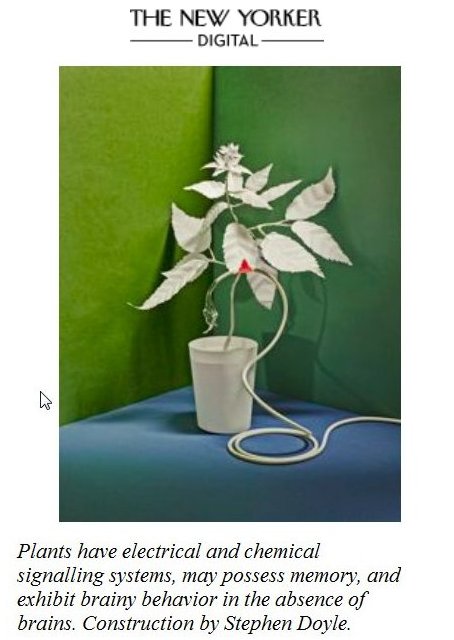
The idea that plants might be intelligent (some would say even sentient) in some manner and worthy of study is the work of a group of scientists who prefer to categorize their work as “Plant Neurobiology.” Predictably. Many scientists, botanists and other academics were outraged. According to Michael Pollan, Depending on whom you talk to in the plant sciences today, the field of plant neurobiology represents either a radical new paradigm in our understanding of life or a slide back down into the murky scientific waters last stirred up by [the book] The Secret Life of Plants.”

In case you’re not familiar with The Secret Life of Plants, first published in 1973, one claim it made is that plants were sentient, even though lacking a nervous system or brain. Pollan says the book’s  “… most memorable passages described experiments of a former C.I.A. polygraph expert named Cleve Backster, who, in 1966, on a whim, hooked up a galvanometer to the leaf of a dracaena, a houseplant that he kept in his office. To his astonishment, Backster found that simply by imagining the dracaena being set on fire he could make it rouse the needle of the polygraph machine.”

Not surprisingly, legitimate researchers could not duplicate these results. Since it’s publication, much of the reported science in The Secret Life of Plants” has been discredited.  But Pollan says the cultural damage was significant and hindered important work:

According to Daniel Chamovitz, an Israeli biologist who is the author of the recent book What a Plant Knows, [The Secret Life of Plants] stymied important research on plant behavior as scientists became wary of any studies that hinted at parallels between animal senses and plant senses.” Others contend that “The Secret Life of Plants” led to “self-censorship” among researchers seeking to explore the “possible homologies between neurobiology and phytobiology”; that is, the possibility that plants are much more intelligent and much more like us than most people think—capable of cognition, communication, information processing, computation, learning, and memory.


That’s the backstory to Pollan’s fascinating review of the work plant neurobiologists are doing today.  That research is covered in depth in Pollan’s piece.  I’ll recount just one example, experiments on Mimosa pudica, better known as the Sensitive Plant.
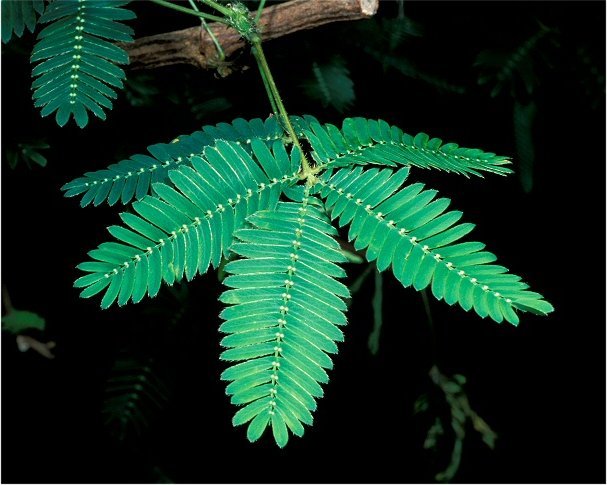
Mimosa pudica leaves open

Mimosa pudica leaves open.  Photo © BarryRice/sarracenia.com

Most of us are familiar with the way the leaves of this plant respond immediately to touch by folding up, presumably to frighten away insects. The leaves also collapse when the plant is dropped.
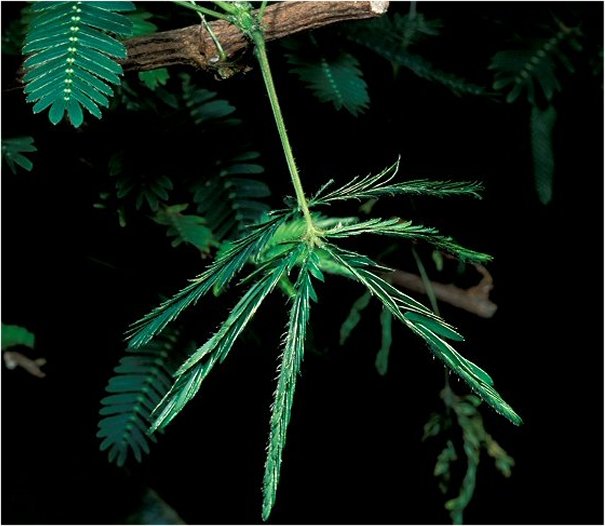
Mimosa pudica leaves closed

Mimosa pudica leaves closed. Photo © Barry Rice/sarracenia.com

Monica Gagliano, an animal ecologist at the University of Western Australia based her experiment with the sensitive plant on a set of protocols commonly used to test learning in animals. Her unpublished paper was presented at a scientific conference at the University of British Columbia in Vancouver, B.C. She potted 56 mimosa plants and designed a system to drop the pots from a height of fifteen centimeters every five seconds. Each training session involved 60 drops. Gagliano reported the mimosas sarted to reopen their leaves after just four to six drops; and by the end of the series their leaves remained completely open as if they concluded this stimulus could be completely ignored.

Even more interesting, Gagliano retested her plants after a week and found they continued to disregard the drop stimilus, as if they remembered what they had learned.  Gagliano’s conclusions suggested that “brains and neurons are a sophisticated solution but not a necessary requirement for learning.”

Another fascinating example Pollan detailed concerned underground plant networks that forest trees establish using mycorrhizal fungi to connect roots and enable the exchange of information and even materials. Dubbed the “wood-wide web” by researchers, it allows scores of trees in a forest to convey warnings of insect attacks, and also to deliver carbon, nitrogen and water to trees in need.

Pollan concludes that “when most of us think of plants, to the extent that we think about them at all, we think of them as old — holdovers from a simpler, pre-human evolutionary past.”  But, Pollan opines, “that for plant neurobiologists these plant behaviors hold the key to a future that will be organized around systems and technologies that are networked, decentralized, modular, reiterated, redundant and — green, able to nourish themselves on light. Plants are the great symbol of modernity, their ‘brainlessness’ turns out to be their strength, and perhaps the most valuable inspiration we can take from them.”

So if your interested in reading the entire article online The archive stores digital replicas of every print issue of The New Yorker published since 1925. Subscribers can explore the archive at archives.newyorker.com. After you’re done reading it, like me, you might no longer feel sheepish about talking, singing and engaging with the plants in your own garden.
Hartley Metal Labels

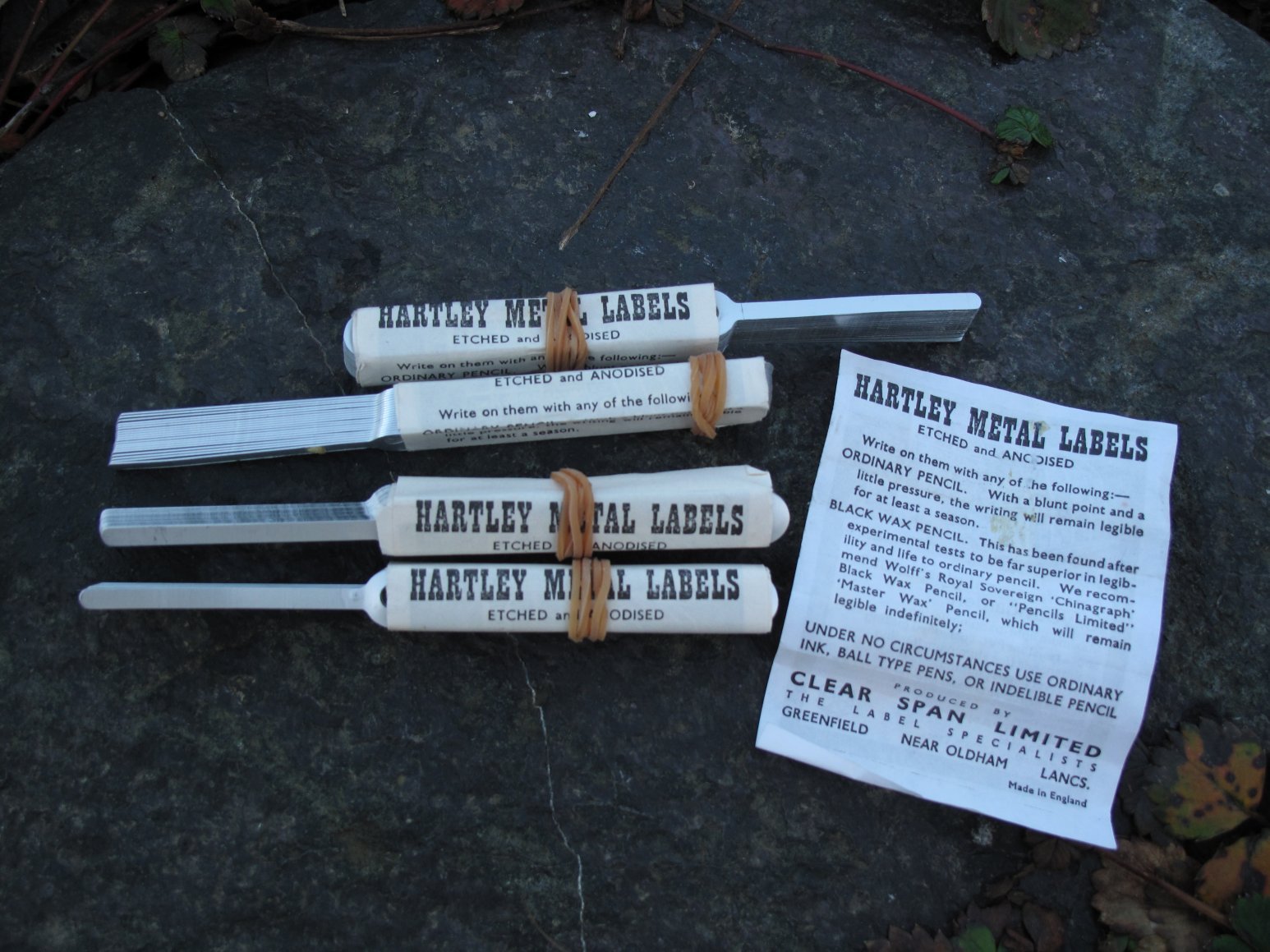
And now a bit of plant tag nostalgia. Made in England by the British company Clear Span, Hartley Metal Labels are undoubtedly no longer offered for sale anywhere. These “vintage” plant tags were offered to me at recent meeting of the Northwest Chapter of the North American Rock Garden Society.

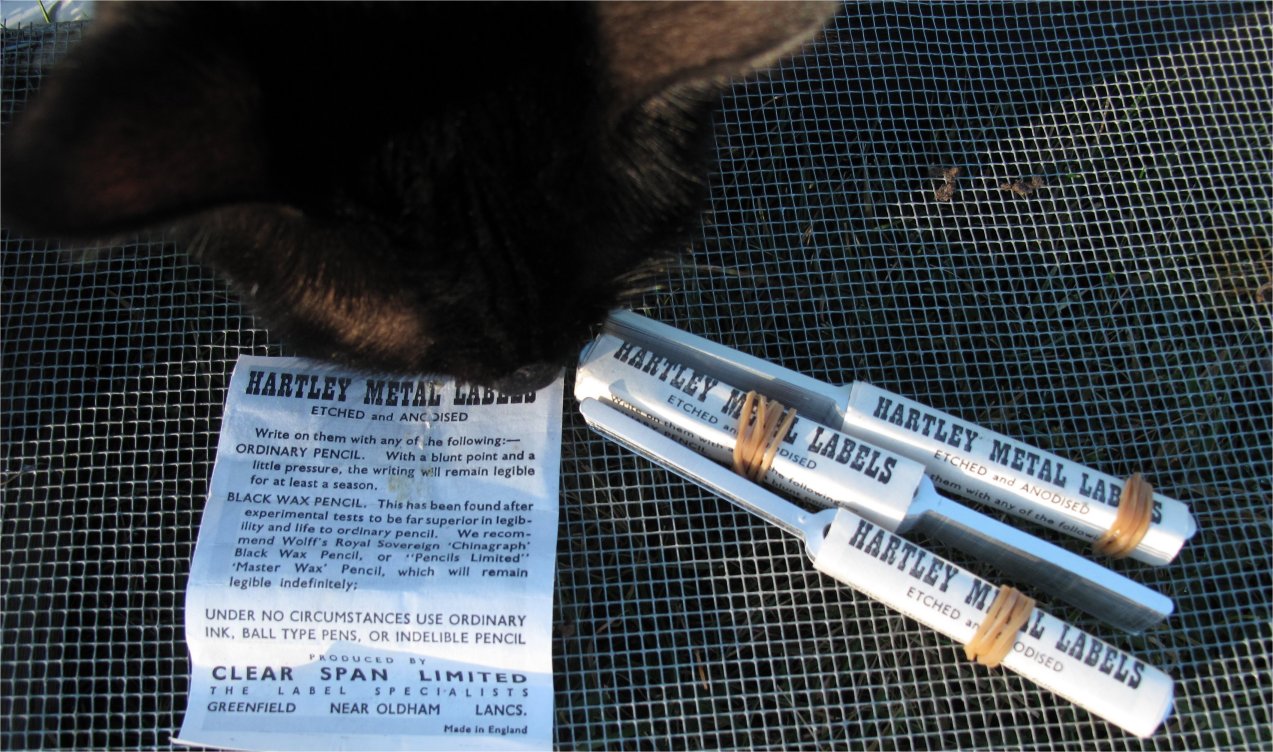
Hartley Metal Labels

Hartley Metal Labels (Click photo to more easily read instruction sheet)

Age wise, our chapter skews toward the senior end of the spectrum.  Many of us are downsizing and that means going through our gardening stuff. So to raise money for the chapter, the owner who unearthed the labels was offering them at a recent meeting’s silent auction.  She was planning to continue her love of rock garden plants, but no longer had use for these beauties.

hartley label6

I immediately fell in love with the elegant slim labels manufactured of anodized aluminum. The marking surface is slightly concave, which adds to the longevity of the label.

hartley label2

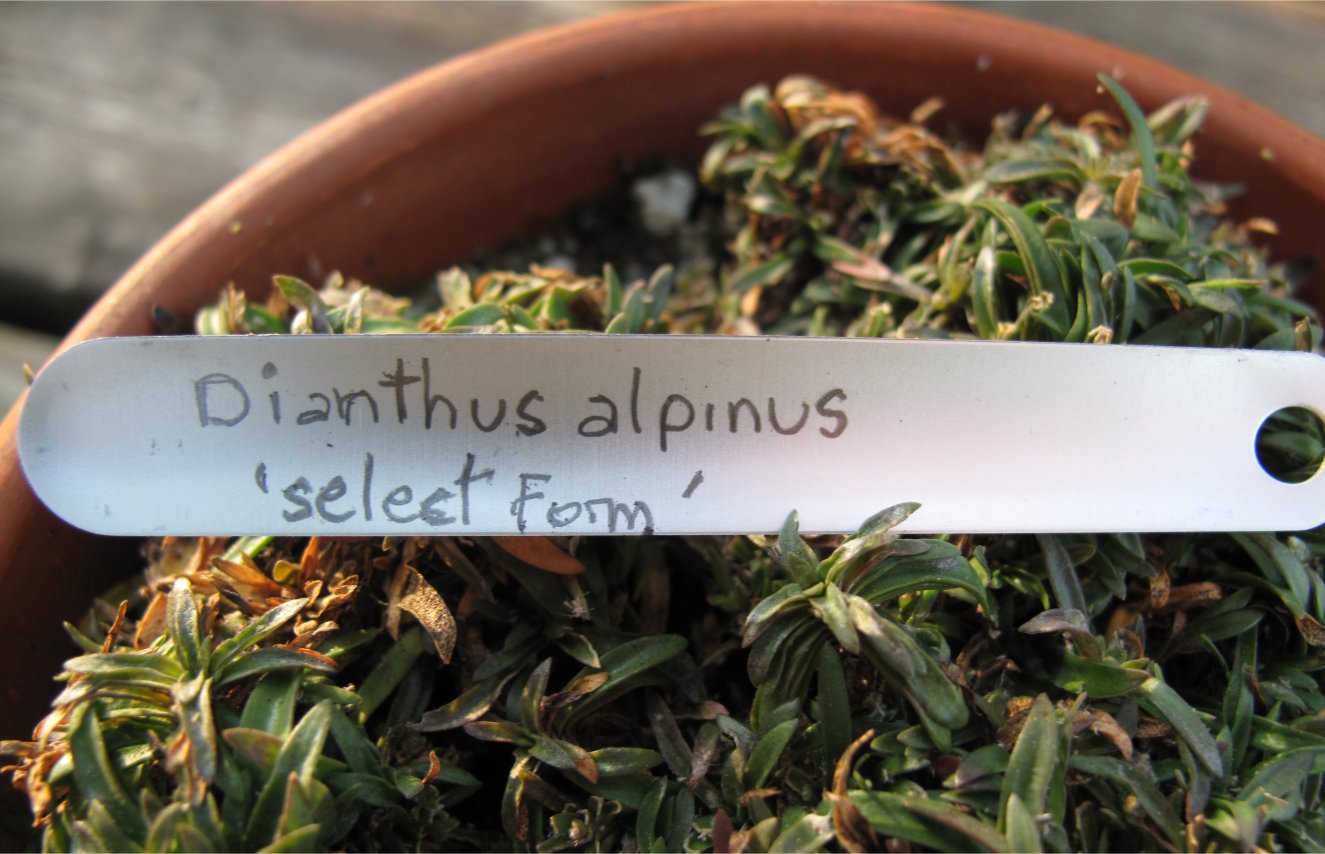
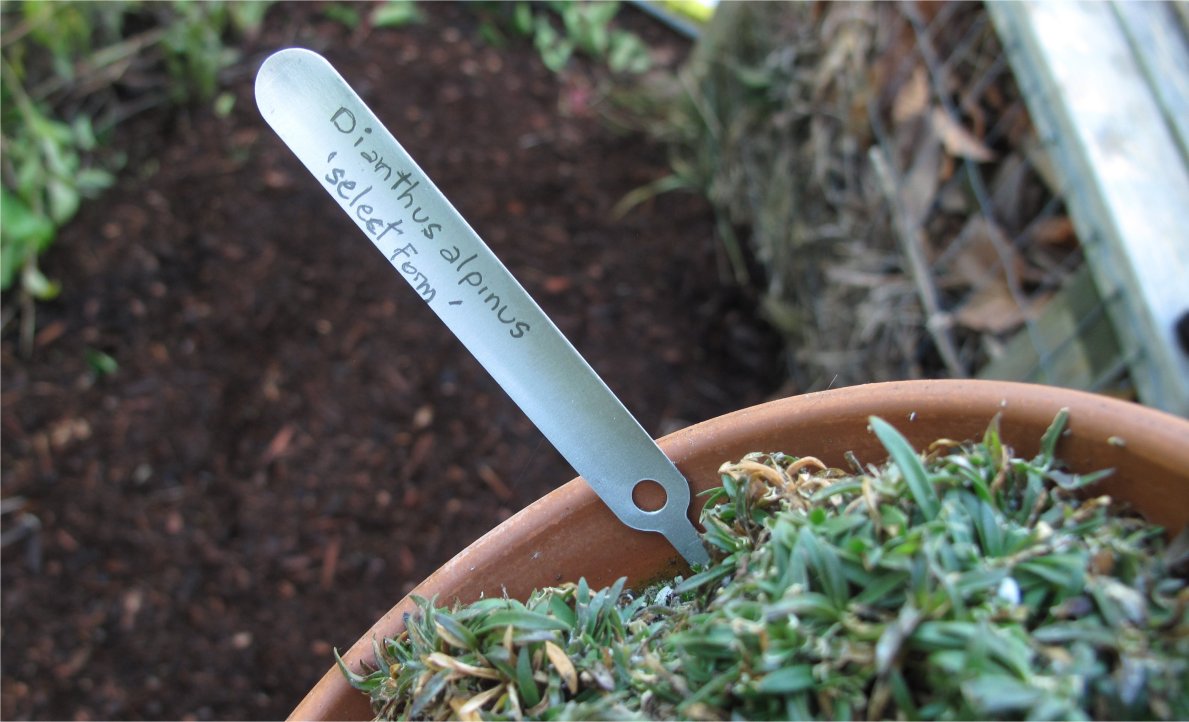
Label written with ordinary #2 pencil

As the manufacturer suggested decades ago, ordinary pencil with a blunt tip and a bit of pressure will render a tag that is legible for at least a season. Better still is to use a “wax pencil,” often referred to as a china or grease pencil.

There’s quite an interesting backstory around the Hartley Metal Label.  My cat Zoe seems to be interested in doing some of the research.

Zoe looking for more info

Zoe looking for more info

Clear Span’s founder, Vincent Hartley started his company in 1938, primarily to make greenhouses.  Hartley, an inventor, entrepreneur and Fellow of the Royal Horticultural Society, was known for quite a few inventions.  You can read more about Vincent Hartley here,  Remembering Vincent Hartley.

Zonal Denial, Garden Thugs and Me

Two apt gardening terms epitomize my sometimes self destructive plant selection process. I clearly practice the art of  “zonal denial,” which I define as a compulsive attraction to plants at the edge of my zone, best described as Sunset Zone 5 ½ or  USDA Zone 8b.  (At 370 feet above sea level and enjoying close proximity to the moderating influence of Puget Sound,  I figure I’m actually somewhere in between Sunset Zone 5 and Oregon’s Willamette Valley Sunset Zone 6, hence the one-half.)

Thunbergia gregorii - Orange Clock Vine - Hardy to USDA Zone 9

Thunbergia gregorii, Orange Clock Vine, Hardy to USDA Zone 9

The Sunset Magazine zones, unlike the USDA hardiness scheme, take account summer high temperatures, regional micro climates and other factors, rather than simply winter maximum recorded low temps.

As much as I would like to take credit, I can’t claim to have coined the term zonal denial.  I first saw the term on a sign at Cistus Nursery in Portland Oregon.

The time of year was late fall, and in a section of the nursery defined by a lath house-like structure, a small sign announced that the plants inside were of the “zonal denial” persuasion!  I bought three or four of these beauties in gallon pots.

heater

— Zonal denial mitigation tool —

I should have paid closer attention to the outdoor propane heater atop a typical 20 gallon LP tank pointed directly at my purchases.

Many of my zonal denial plants — in anticipation of a major winter cold snap — are consigned to pots, moved into a crammed 8 X 14 foot greenhouse or covered in mulch, burlap and other sundry protective improvisations. Many others are long since gone.

When not buying plants or seeds better suited to San Diego or the Willamette Valley in Oregon, I’m guilty of planting aggressive spreaders that refuse to coexist with other less robust plants.  These thuggish plants are often attractive, but are lousy at harmonizing with their more well mannered neighbors.

Actually that’s not entirely accurate.  Initially many aggressive spreaders seem okay, filling in nicely and covering empty space. Later on when they exceed their boundaries, overwhelm neighboring plants, and require endless trimming, yanking and composting do the consequences become clear.

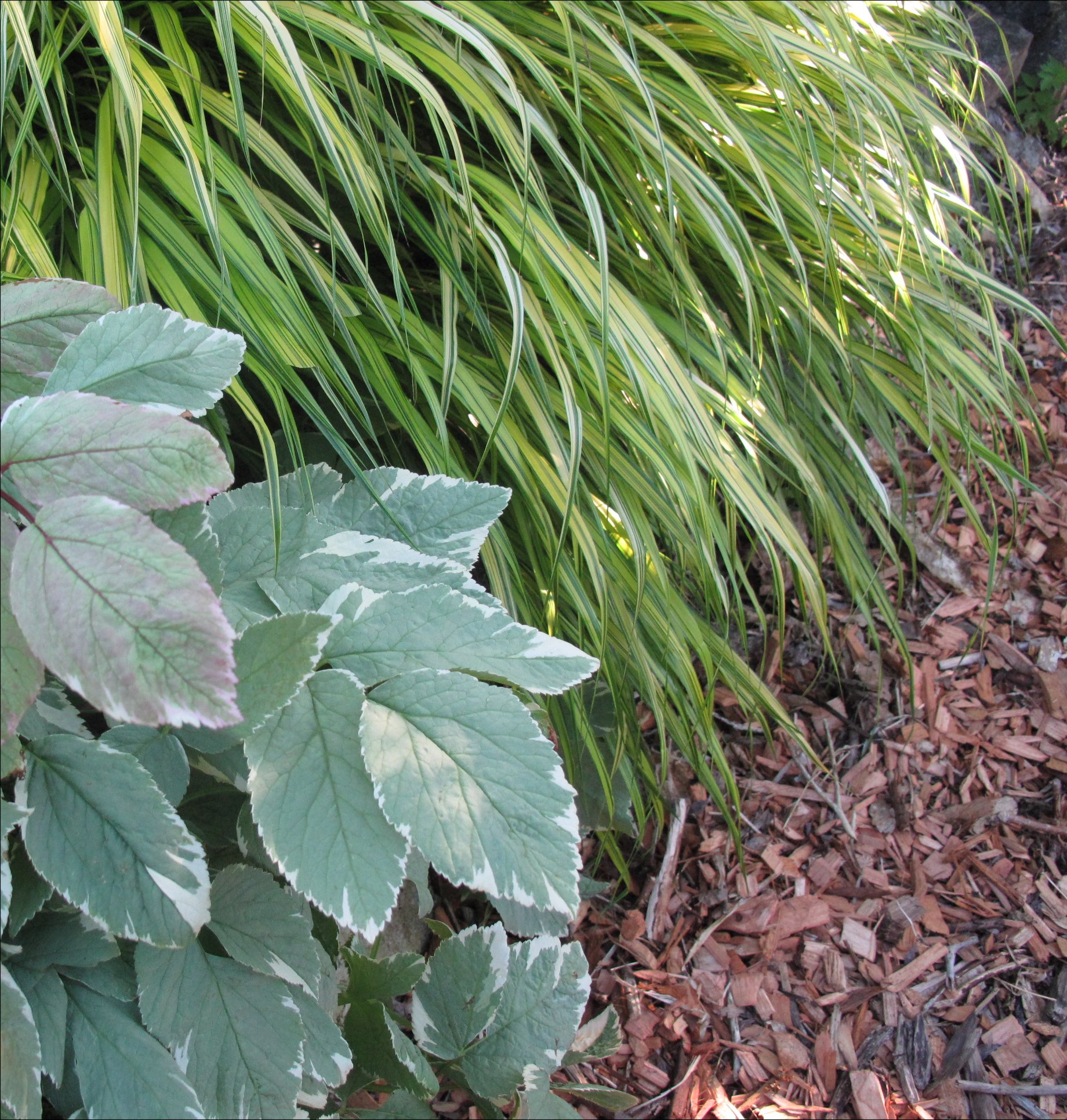
Here’s just one example of one of my endless struggles,  a variegated ground elder vs. Japanese Fountain Grass (Hakonechloa macra ‘Aureola’).

hakonokloa ground elder

Japanese Fountain Grass and Aegopodium podagraria ‘variegatum’

The above photo gives the impression these two handsome plants are getting along side by side. What you might not guess is the aggressive ground elder when left to its own devices will completely overwhelm the slow growing Japanese fountain grass.

hakonokloa ground elder2

Aegopodium podagraria ‘variegatum’ aka ground elder, bishop’s weed

In fact, I’ve spent more time than I care to admit picking this tenacious spreader out of the Japanese Fountain Grass, not to mention from the wood chip path.

ground elder roots

Ground Elder proudly displaying its metastatic root

The Royal Horticultural Society doesn’t mince words:   “Aegopodium podagraria, ground elder  is a fast-growing, invasive, perennial weed that can spread quickly to form a carpet of foliage that will crowd out less-vigorous plants in beds and borders…It spreads via rhizomes (underground stems), which can regenerate from a just a tiny fragment left in the ground.”

So how did a savvy plant guy like me introduce this thug to my garden?

Four years ago I bought a few four inch pots along with some annuals to decorate the base of our son’s “Chuppa” or marriage canopy.  It was an October wedding, annuals were not in great supply and the variegation was attractive.

After the wedding, not wanting to waste this lovely variegated ground cover, I planted the leftovers without bothering to investigate the plant’s questionable habit. I soon learned this “energetic” perennial would keep my as busy as the Euphorbia amygdaloides var. robbiae (Mrs. Robb’s bonnet) that likewise has a rhizomatus root system that can only be described as invasive.

euphorbia

— Mrs. Robb’s Bonnet beside (and invading) a wood chip path —

In the Euphorbia’s case, what I wanted was to quickly establish a large single swath of plants in a defined border.  The euphorbia obliged and I’ve been an energetic weeder ever since.