
Walker’s Low Catmint—Nepeta x faassenii
The Perennial Plant Association selected Nepeta x faassenii ‘Walker’s Low’ as their Plant of the Year 2007. This herbaceous perennial in the mint family (Lamiaceae) is hardy in zones 3-8. The common name for the genus Nepeta (catmint) comes from the attractiveness to cats of the aromatic volatiles released from the broken stems. Although Nepeta cataria is the true catnip which drives house cats ecstatic, the leaves of ‘Walker’s Low’ are also attractive, albeit somewhat less enticing, to cats.
Nepeta racemosa, also commonly called catmint, is native to the Caucuses and northern Iran. It is a low-growing perennial that typically forms a spreading clump of decumbent, ascending and upright stems to 12” tall and 18” wide. Features gray-green, hairy, ovate leaves (to 1” long) with crenate margins, prominent veining and heart-shaped bases. Leaves are highly aromatic when crushed or bruised. Pale lilac to deep violet two-lipped flowers (1/ 2” long) clustered in loose raceme-like verticillasters (false whorls) bloom in spring. Bloom may continue throughout summer into early fall under proper growing conditions and with proper shearing of spent flowers. Although Nepeta cataria is the true catnip which drives house cats ecstatic. The leaves of the Nepeta racemosa species are attractive, but also less appealing to cats.
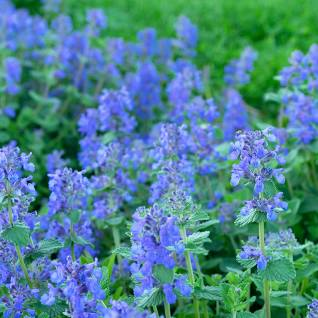
Walker’s Low catmint is an herbaceous perennial in the Lamiaceae (mint) family. It originated in west Asia and is a hybrid plant, the result of a cross between Nepeta racemosa and Nepeta nepetella. It was first cultivated by Faassen Nurseries in the Netherlands and named for a garden called Walker’s Low.
Walker’s Low catmint thrives in full sun and dry, even rocky, soil. If planted in the south, it should be in afternoon shade. In ideal conditions, it may grow as high as 2 feet with a spread of 18 to 36 inches. This plant can be divided in the spring and will not take over a garden bed, unlike most plants in the mint family.
On the other hand, If you are looking for something attractive and neat to fill a flower bed, N. mussinii (syn. N. racemosa) is a better bet. This is the species you’ll typically see listed generically as “catmint.”
Dear Readers, Beware of my photographs identity, and also the various immense genus and species names. Such names are often the opinions of nurseries, their growers and suppliers, whereas the mint family (Lamiaceae ) is enormous.

 Pacific Northwest Specialty Plants