
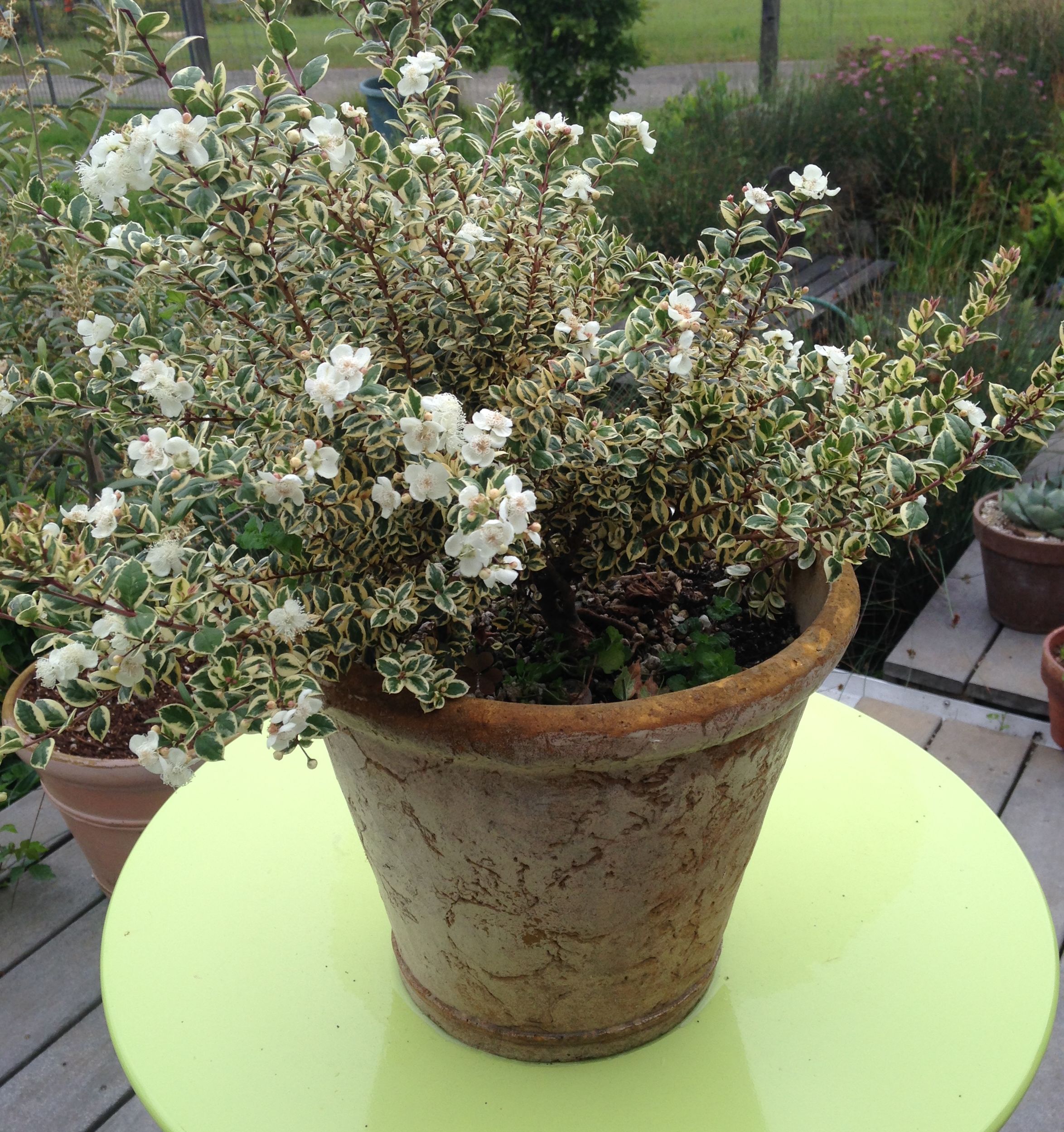
L. apiculata ‘Glanleam Gold’ Click picture to enlarge the view
A couple of years ago I picked up this variegated Chilean myrtle tree in a gallon pot at Robinwood Nursery here on Vashon Island.
Robinwood, a wholesale nursery founded in 1991, has recently opened their nursery to the public a few times a year.
Visiting Robinwood Nursery is definitely worth a trip to Vashon. They have a couple of events scheduled for this June, and the annual fall open house at the nursery is in early September. They have a fine selection of plants including some shrubs and trees whose origin is South America, specifically, Eucryphia nymansensis, Azara micrphylla variegata, Ugni molinae and L. apiculata ‘Glanleam Gold.’
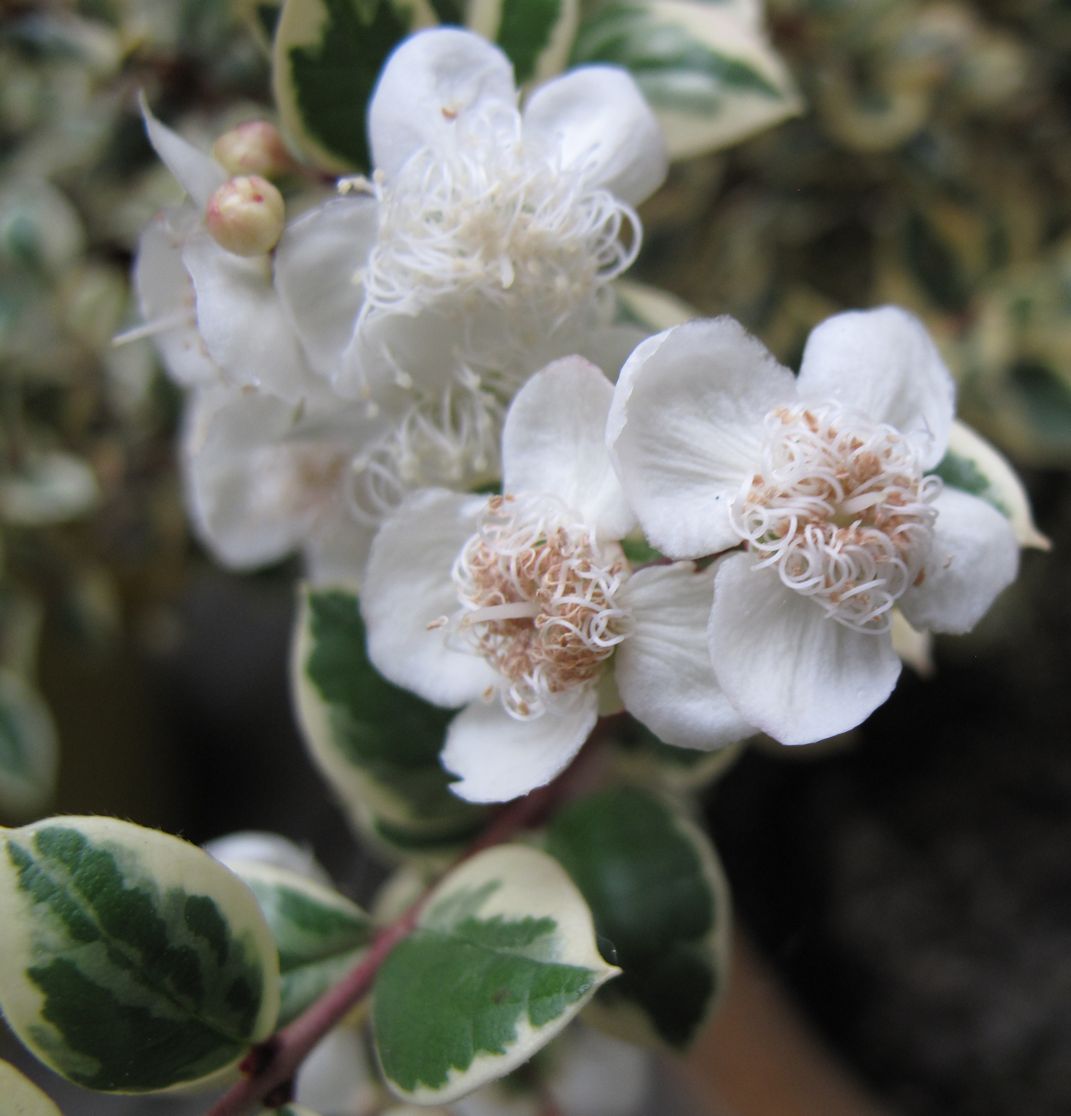
Click photo for a closer look
L. apiculata is a native of Chile and naturally I include it in my “Zonal Denial” category. I’m growing it in a pot and I’ve over wintered it in my “cold” greenhouse, which has supplemental heat only on the coldest winter days, keeping minimum temperatures above 38° F.
It has responded by blooming heavily for the first time since I purchased it . The small white blooms invite close inspection, especially against the backdrop of the variegated foliage.
These flowers are about three-fourths of an inch wide, consist of four cupped-shaped, white petals, surrounded by a puff of numerous filigree like stamens. I’m looking forward to adding a photo of the small berries, which appear in the fall and are a deep purple-black.
The following description is from the website of the BlueBell Arboretum & Nursery in Leicestershire, England:
Unusual, evergreen aromatic shrub which has dark green leaves with attractive golden edges and clusters of pretty white flowers summer. Luma apiculata ‘Glanleam Gold’ is a handsome yet slow growing shrub, the original plant at Glanleam, on the west coast of Ireland, is only 2 – 3 meters tall after many years growth. Luma apiculata ‘Glanleam Gold’ is best planted in a warm position in sun or light shade, with plenty of shelter from cold winter winds. Unless you have a very warm garden, Luma apiculata ‘Glanleam Gold’ usually grows best in southern areas of the U.K., in particularly Devon and Cornwall.
For almost everything else you need to know about Chilean myrtle, check out this post by Seattle tree maven, plant expert and writer Arthur Lee Jacobson (be sure to scroll down for the pictures).



 Pacific Northwest Specialty Plants